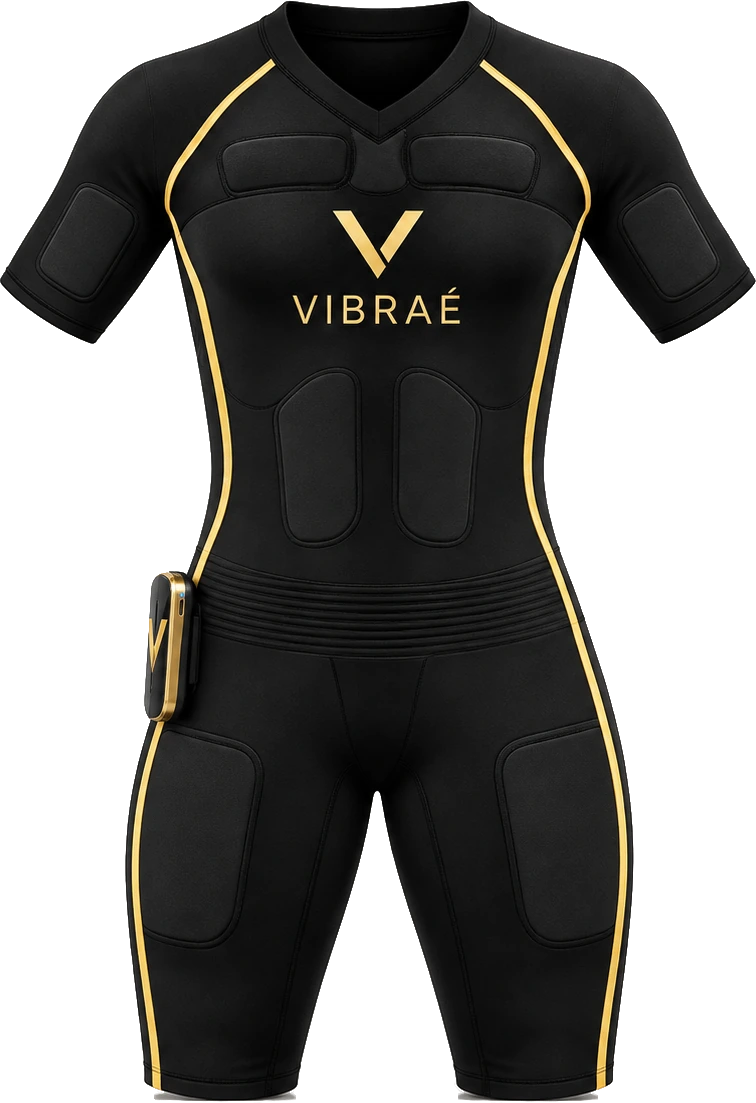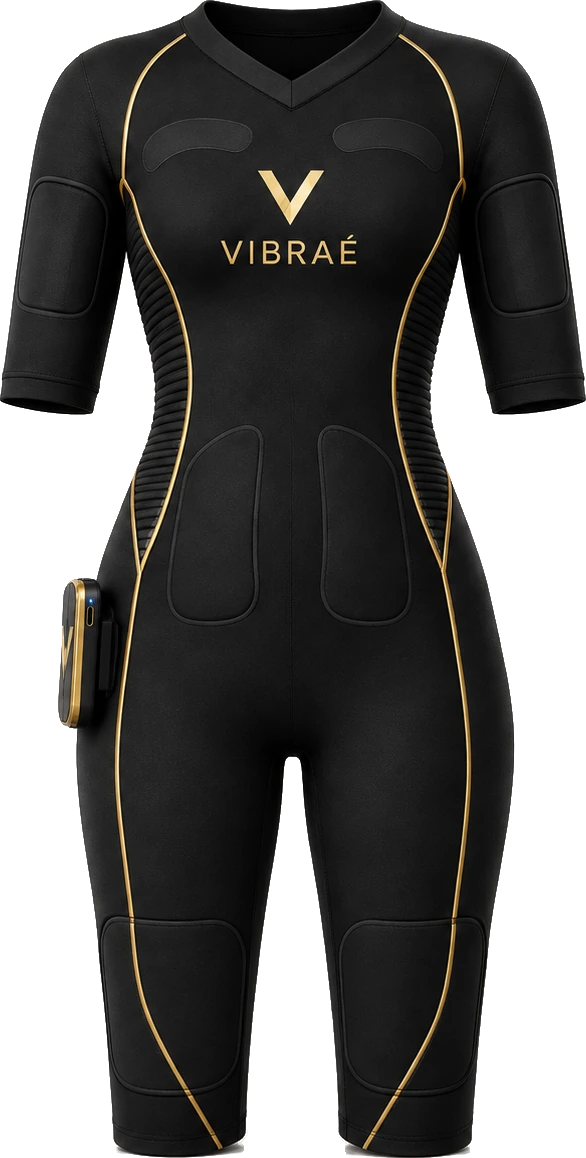
There is no single honest answer to the question of how much an EMS studio earns. Two studios with the same equipment can have completely different results, because one works in the centre of a big city with a full schedule from seven in the morning, while the other is still building its client base in a smaller town. Any figure given without these caveats is a promise no one can keep.
What can be shown, though, is what a studio's revenue is made up of, which numbers depend on you and which on the market, and how to calculate it for your own location. That is what this article is about. At the end you will find a link to a calculator where you can enter your own prices and occupancy.
Revenue is the product of a few simple numbers
Revenue from one-to-one training is calculated the same way in every studio: the session price times the number of sessions per day on one station, times the number of stations, times the number of working days per week. The weekly result is multiplied by 4.33, because that is how many weeks an average month has. The calculator on the partner page works it out the same way.

This formula is simple, but it shows well where the opportunities lie. You cannot raise the price indefinitely, because it has a market ceiling. There is also a finite number of days in a week. Most can be changed in two places: in the number of sessions that actually take place each day, and in the number of people the trainer works with at the same time.
Session price: what to expect on the market
A single EMS session in Poland costs on average from 130 to 180 zł. The price per visit falls as the package size grows, because the client pays upfront and commits to regularity:
| Type of purchase | Price per visit |
|---|---|
| Single session | 160–180 zł |
| A package of 4 sessions | 150–160 zł |
| A package of 8 sessions | 130–150 zł |
| A package of 12 sessions | 120–130 zł |
At first glance, packages lower the revenue from a single session. In practice it is the other way round: a client who has paid for twelve visits comes regularly, sees results sooner and is more likely to buy another package. A studio that sells mainly single visits has a higher average price, but a less predictable schedule and more empty hours.
Prices depend on the city, the area and what the service is combined with. In beauty salons in big cities the treatment is sometimes priced higher; in smaller towns closer to the lower end. That is why you always put prices from your own area into the calculation, not the national average.
Sessions per day: how many really fit into the schedule
The number of sessions you can plan and the number of sessions that actually take place are two different things. A studio's schedule has peaks: in the morning before work and in the late afternoon. In the middle of the day there is less traffic, and it is precisely these hours that determine what the average looks like.
The number of sessions is also affected by the preparation time between clients. In systems where you have to moisten the vest, connect cables and check which electrodes conduct before the session, part of every hour goes on preparation. The Vibraé suit is put on dry, the controller is clipped into the suit, and the session starts as soon as it connects to the app. Every moment saved between clients makes room for another session during the day.
When planning, it is best to assume a cautious number of sessions for an ordinary day, not for the best week of the year. January and September look different from July.
Stations and people: where capacity grows
The strongest lever in the whole calculation is the number of people one trainer works with at the same time. With a wired system it is usually one person, because the client is connected to the device by a cable. A wireless suit changes this setup.
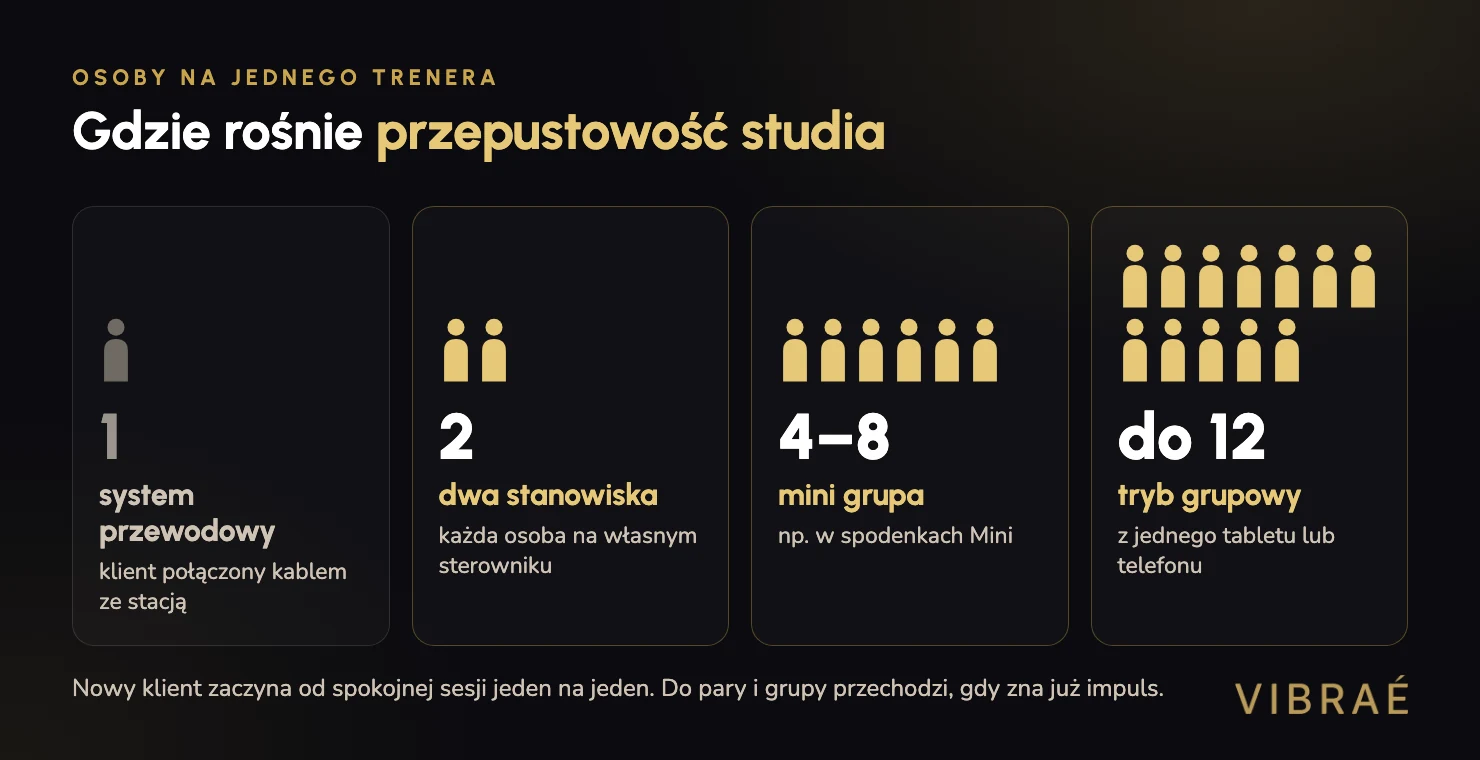
A trainer can work with two people at once, each on their own controller and with their own settings. A small group has four to eight people, and the group mode in the app lets you run up to twelve people from one tablet or phone. The session continues even when the tablet screen goes dark, so the trainer can go up to a client and correct their technique.
More people per session means higher revenue from the same hour, but also greater responsibility. A new client starts with a calm one-to-one session and moves on to working in pairs or in a group once they already know the impulse and the exercises. The trainer has to be able to see every participant and immediately ease the intensity of a single muscle group without changing the others.
Group classes are calculated differently
For group classes, revenue is calculated per person rather than per station: the price per person per class times the number of participants, times the number of classes per week, times 4.33. The price per person is lower than for an individual session, because the client does not have a trainer just for themselves, but one hour of classes can bring in more than several one-to-one sessions.
Group classes work particularly well in fitness clubs and in studios with a large hall. The Mini shorts are well suited to groups; they cover the thighs, buttocks and love handles and are the simplest way into the method. A group is also a good way to offer a lower entry price for new clients who want to try it first before buying individual training.
Treatments, or revenue from empty hours
The Vibraé app has eight ready-made treatments, including Firming, Anti-cellulite, Pain relief and Relax. During a treatment the client lies down and the muscles work on their own. The app switches the phases and changes the parameters by itself. The person running the treatment sets the intensity at the start, stays with the client and adjusts it when the client asks, but does not have to lead every exercise as in a workout.
For a training studio, treatments are a way to fill the hours when fewer people train, and to keep a client who is having a bad day or a break from training. It is the same equipment, but a different service and often a different client: someone who will never like exercising will gladly come for a series of back or body-shaping treatments. We describe what this looks like in practice in the article EMS in a beauty salon: treatments, introducing the service and profitability.
Revenue is not yet profit
The calculator shows revenue, that is, what clients pay the studio. To know how much of it is left, you subtract the costs from revenue: rent, salaries, software, marketing, accounting, laundry and energy, and equipment financing. Some of them are fixed and have to be paid regardless of the number of clients; some grow with every session.
That is why, alongside revenue, you always calculate the break-even point, meaning the number of sessions after which revenue covers all of the month's costs. You will find the formula and a step-by-step example in the guide how to open an EMS studio, and we write about when EMS pays for itself and when it just takes up space in the article EMS in a training studio.
What really increases a studio's revenue
- Clients who stay. The cheapest revenue is another package from an existing client. A studio where most people renew their package does not have to find all its clients from scratch every month.
- A second person in the session. When the schedule is full at peak hours, working in pairs lets you serve more clients without adding hours.
- An idea for the middle of the day. Treatments, sessions for seniors, morning groups for parents after the school run. Empty hours are the biggest reserve in every schedule.
- A clear price list with packages. The client should know straight away how much a series costs, not just a single visit.
- Keeping track of packages that are running out. A system that shows whose pass is about to run out lets you offer another one before the client disappears. Core Fitness shows these people in one place.
Honestly about the limitations of this calculation
- It is a method, not a forecast. The formula shows how to calculate, but the result depends on prices and occupancy in your area, and nobody knows those better than you.
- The schedule fills up gradually. The first months look different from a year later, and this has to be taken into account in the financial plan.
- More people per session means more attention. Capacity only grows as long as the trainer still keeps every participant under control.
- Equipment does not generate demand. The best configuration without a plan for winning clients fills the schedule more slowly than an average one with a client base.
Work it out for your studio
W revenue calculator you choose the type of service, that is one-to-one training, beauty treatments or group classes, and enter your own prices, number of sessions, working days and stations. The calculator shows monthly and annual revenue and the formula it used. The starting values are examples, so you will get the most out of it by entering figures from your own price list and schedule.
If you want to go through this calculation with us, arrange a conversation through the page Vibraé for partners. We match the configuration to your way of working, and before deciding you can try the equipment during free tests.
How much does an EMS session cost in a studio?
On average from 130 to 180 zł. A single session usually costs 160–180 zł, in a package of 4 sessions 150–160 zł per visit, in a package of 8 sessions 130–150 zł, and in a package of 12 sessions 120–130 zł. Prices depend on the city and the area.
How do you calculate an EMS studio's revenue?
For one-to-one training: session price × sessions per day per station × number of stations × working days per week × 4.33 weeks per month. For group classes: price per person × participants × classes per week × 4.33. This is how the calculator on the Vibraé partner page works it out.
How much does an EMS studio earn per month?
There is no single honest figure, because the result depends on local prices, schedule occupancy, the number of stations and costs. Instead of an average, it is better to put your own numbers into the formula or the revenue calculator and compare the result with the break-even point.
What increases an EMS studio's revenue the most?
Clients who renew their packages, work in pairs at peak hours, an idea for the empty hours in the middle of the day, such as treatments, and a clear price list with packages. The biggest lever is the number of people one trainer works with at the same time.
How many people can one EMS trainer work with?
With a wired system, usually one. In the wireless Vibraé suit, a trainer works with two people at once, a small group of 4–8 people, or up to 12 people from one tablet, each with their own settings. New clients start with a calm one-to-one session.
Is revenue the same as the studio's profit?
No. From revenue you subtract rent, salaries, software, marketing, accounting, laundry, energy and equipment financing. That is why, alongside revenue, you calculate the break-even point, meaning the number of sessions that cover the month's costs.