You can open an EMS studio in a few weeks, but most people who have done it say the same thing: the most time was taken not by the renovation or the equipment delivery, but by things nobody thought about at the start. Where the suits dry between clients. Who answers the phone while the trainer is running a session. Where to find your first twenty clients before referrals start working.
Updated: 20 October 2026
This article walks you through the opening in the order things actually happen: from deciding what kind of studio you are opening, through the premises, equipment, software and team training, to the first three months of work. Along the way you will also find an opening budget, a break-even formula and a list of formalities to take care of before your first client.
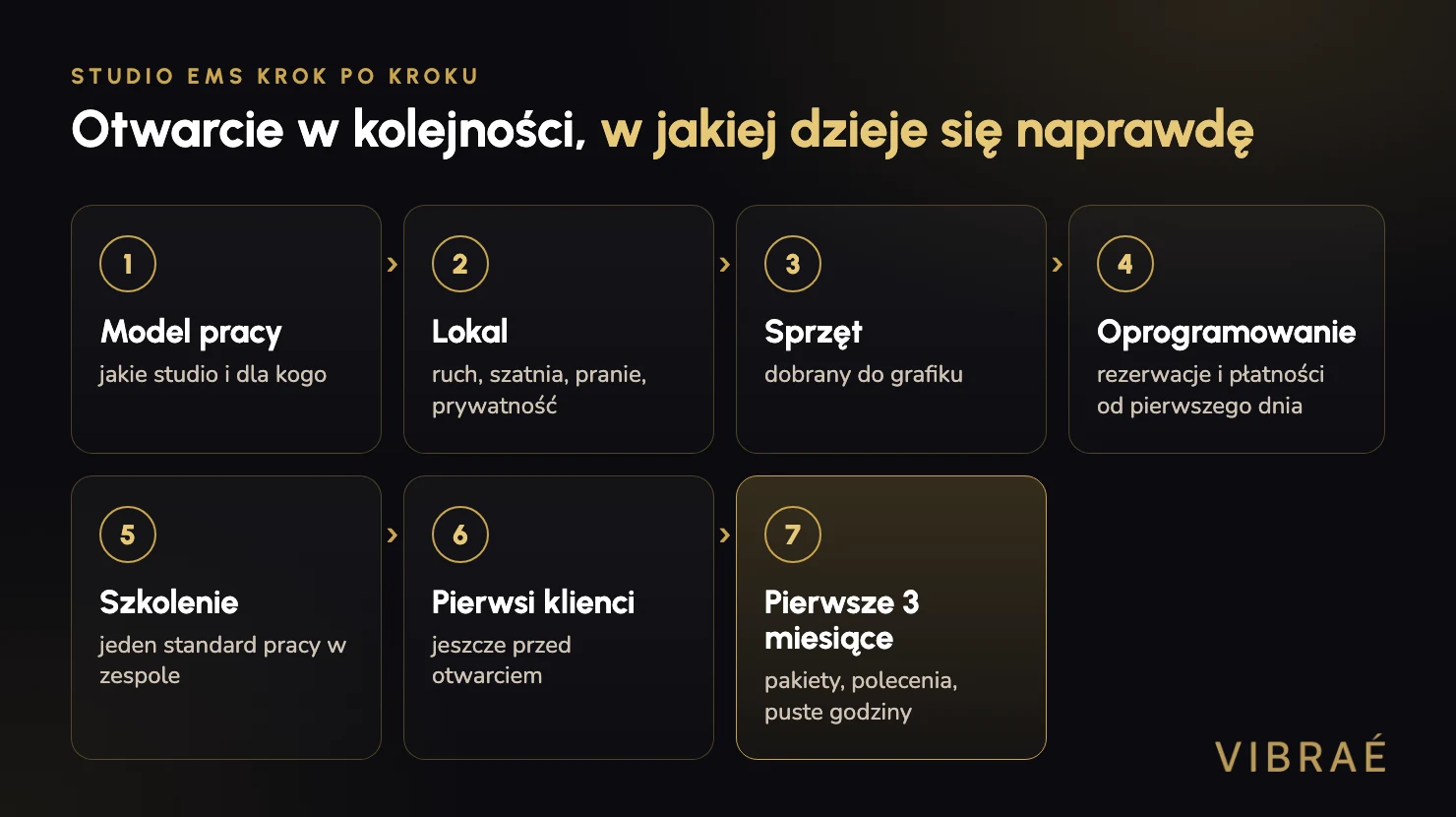
Step 1. Decide what kind of studio you are opening
The first decision is not about equipment or premises, but about who you will sell training to and how. A studio where one trainer works with clients one to one needs different premises, a different number of suits and a different schedule than a place focused on evening small groups or on treatments for clients who do not want to exercise.
The simplest way to start is to ask about your own resources. A personal trainer with a client base has demand but limited hours. A fitness club has space and traffic at reception, but needs a service it can sell for more than a membership. A physiotherapy practice or beauty salon has clients who already trust the place and is looking for a reason for them to come more often. Each of these starting points leads to a different way of working, and the way of working determines everything that happens next.
In practice, the approach that works best is to start with one-to-one sessions and add a second way of working once the schedule starts to fill: two people per session, small groups in the afternoon, or treatments during the hours when fewer people train. In the Vibraé system all these models run on the same equipment, so the decision you make at the start does not close any doors later.
Ways of working at a glance
| Model | What it involves | Who it is for |
|---|---|---|
| 1:1 studio | one trainer, one person, one controller; the highest session price and the full attention of the person leading it | start-up, smaller town, personal trainer |
| Two stations | the trainer leads two people at once, each on their own controller | when the 1:1 schedule starts to fill up |
| Mini groups | a group of 4–8 people in Mini shorts, a lower entry price for the client | clubs, group classes, EMS spinning |
| A station in an existing facility | EMS as an additional service, with no separate premises | fitness clubs, physiotherapy and wellness practices |
| EMS and beauty | sessions in Slim shorts alongside training services | studios with a beauty section |
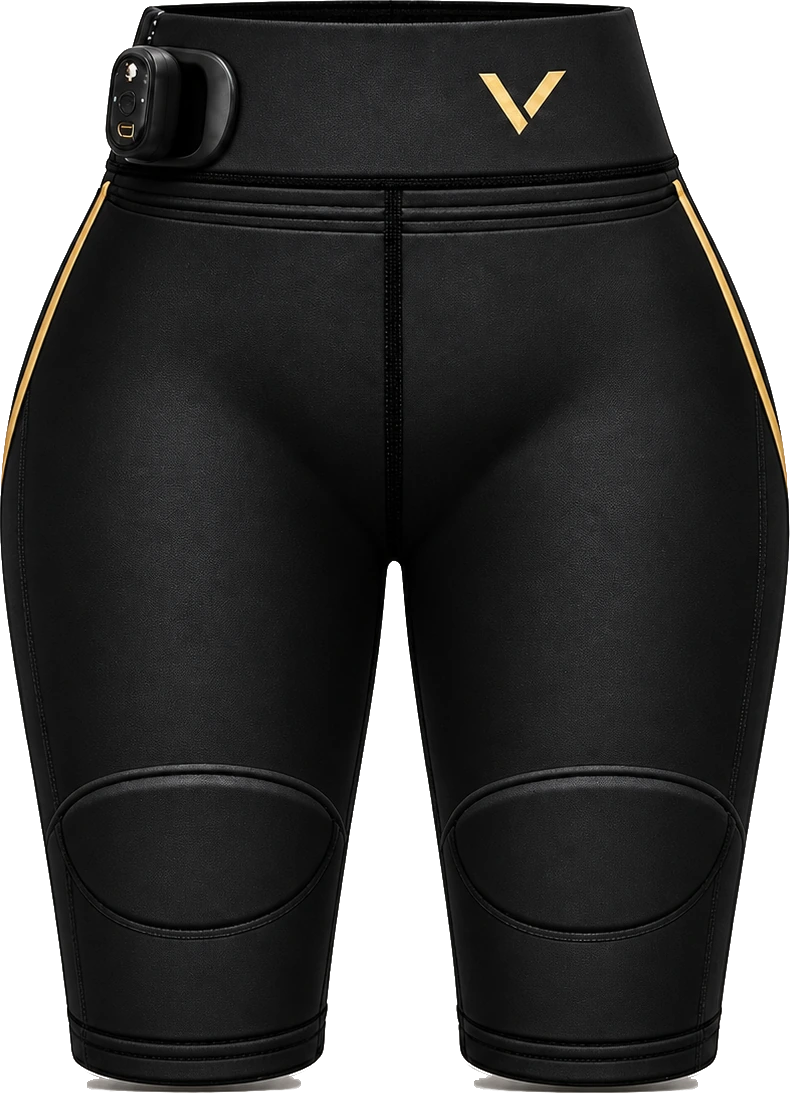
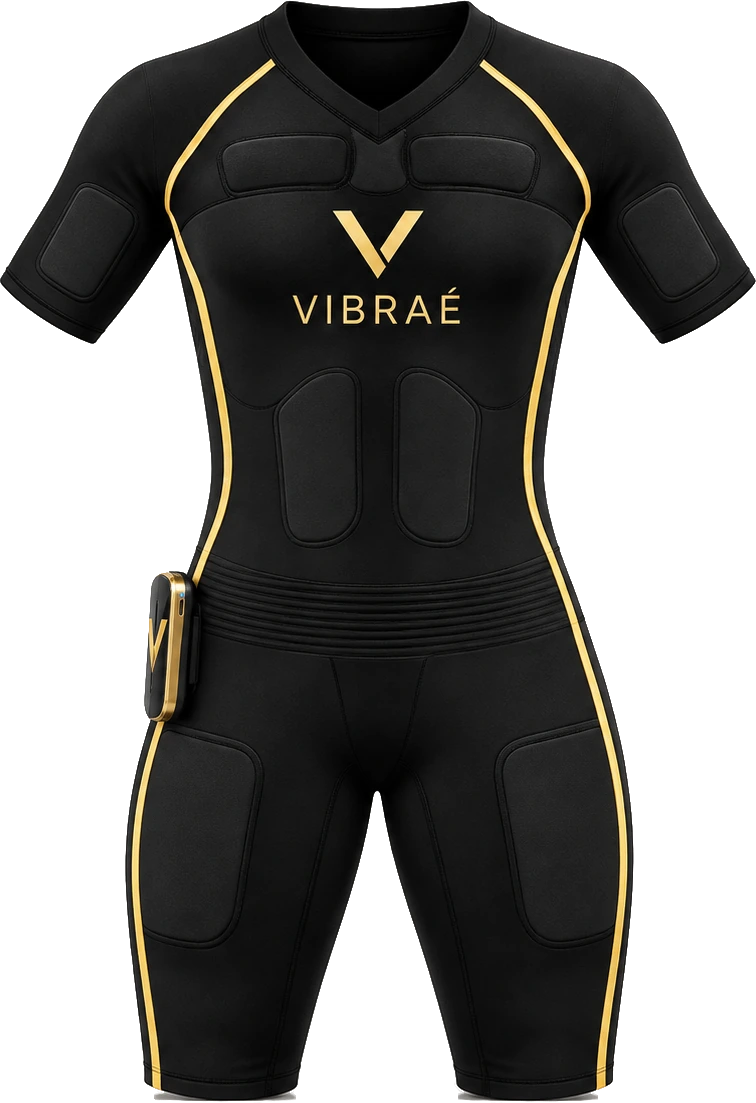
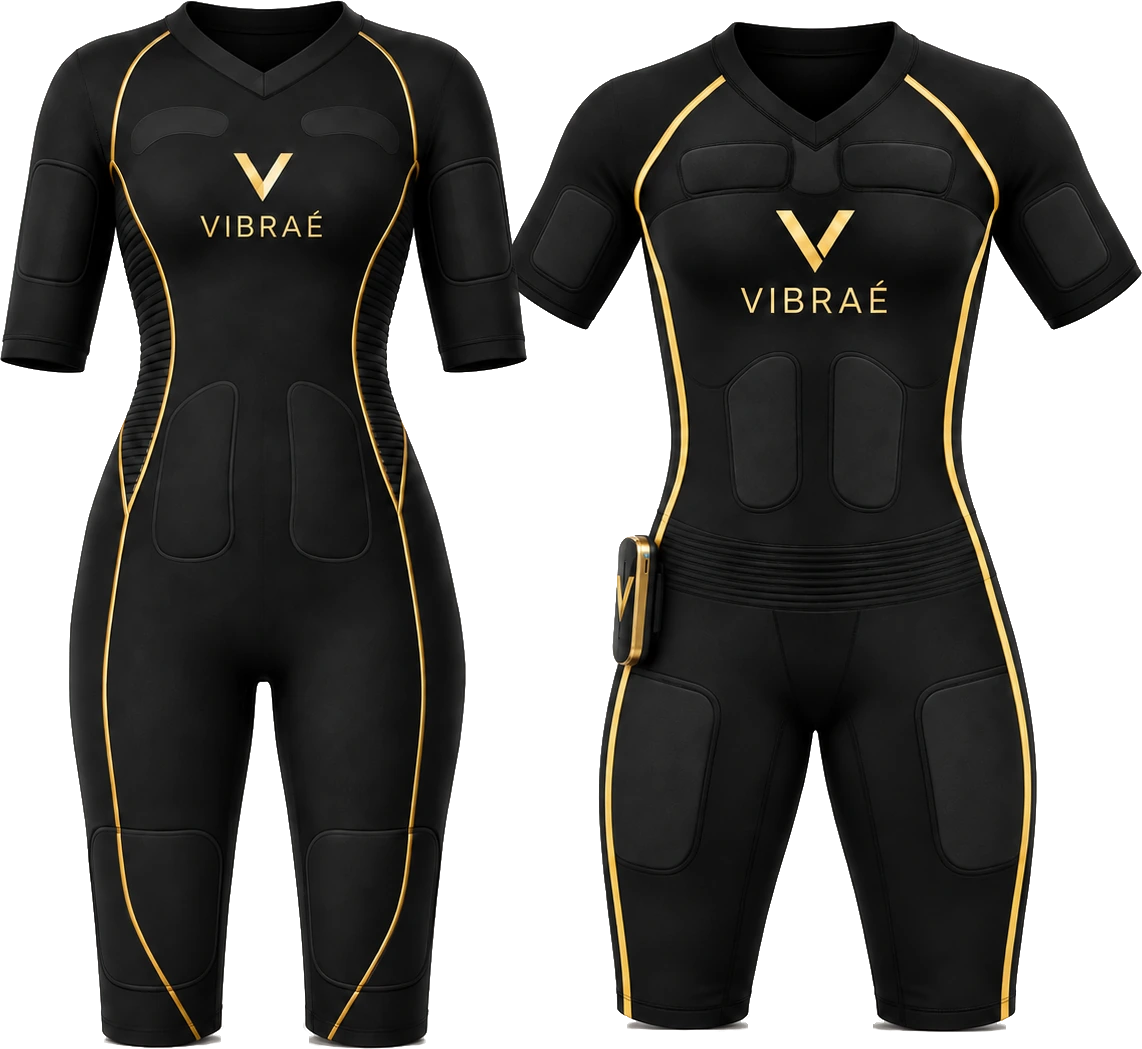
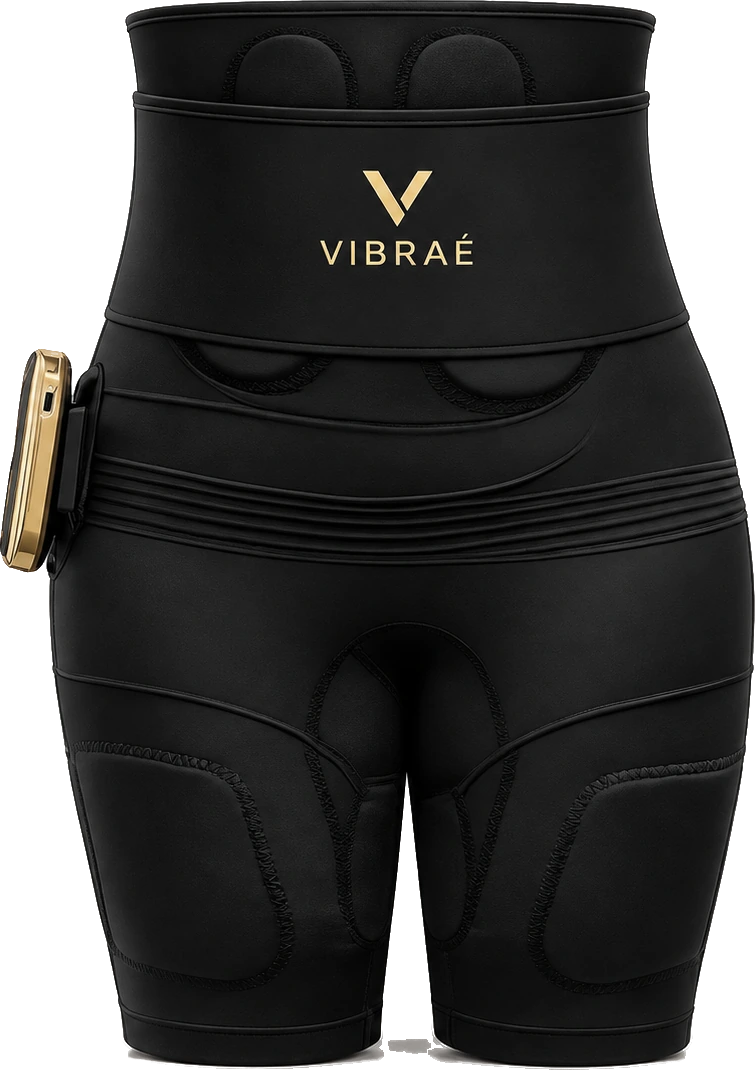
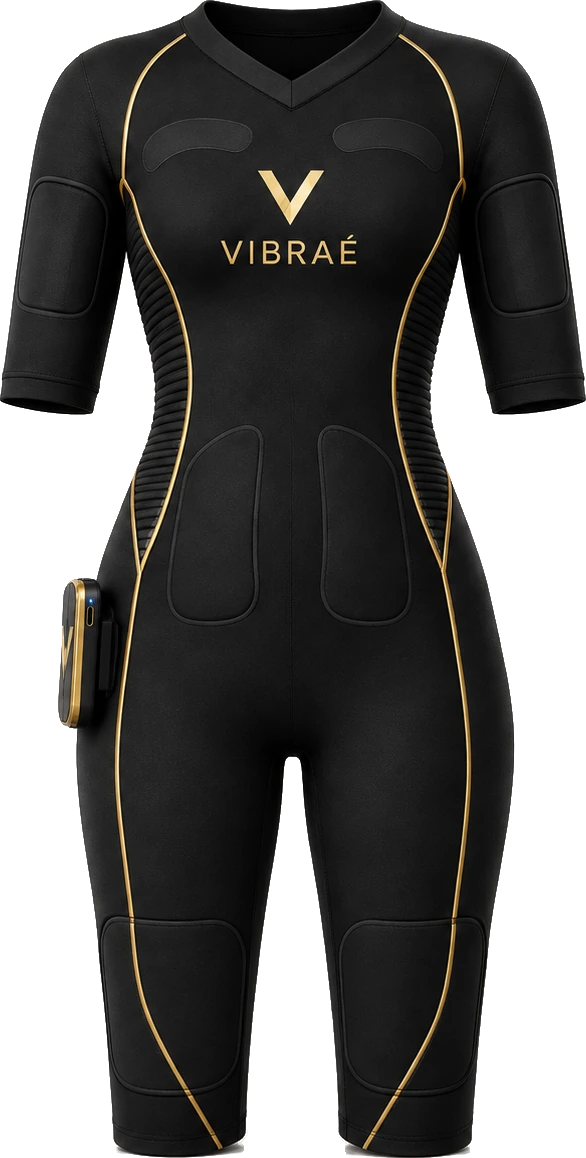
In the Vibraé system all these models are run on one set of equipment: the Body suit works the whole body, the Slim shorts the lower areas, and the Mini shorts prove themselves in groups. The highest revenue usually comes from combining two models — for example 1:1 sessions in the morning and mini groups in the evening, when clients come back from work.
Step 2. Premises: what an EMS studio really needs
An EMS studio does not need a large hall or heavy equipment. What it does need is a few things whose absence only becomes clear after the first full working day.
- Room to move. A client in a wireless suit exercises freely: squats, lunges, work with resistance bands or dumbbells. A one-to-one station needs room for the exercises and for the trainer to move around freely; a small group needs a hall.
- Changing room and bathroom. Clients change before and after the session. This is the first and last impression of the visit, so savings on the changing room show up in reviews faster than savings on anything else.
- Space for washing and drying. Suits are washed regularly, so the washing machine and drying space have to fit the rhythm of the day, not sit in the owner's home.
- A place to charge the controllers. One permanent spot where the controllers charge between sessions saves a lot of stress when the schedule is full.
- Privacy. Many people choose EMS precisely because they do not want to exercise in front of the whole gym. A closed room, or at least a separate part of the hall, is part of the service.
- Access and parking. Clients come several times a week, often straight from work. Premises that are hard to reach at rush hour quietly lose clients.
Market. There is no threshold population figure. What you check is how many studios and clubs operate within travelling distance, what their prices and opening hours are, and whether there is an underserved group: mornings, seniors, couples, group classes.
With a dry system, one item you have to plan for with older solutions disappears: the station for soaking vests. The Vibraé suit is put on dry skin, without water or gel, so you do not need to set aside a wet zone next to the training room.
Step 3. Equipment matched to your schedule, not to a catalogue
It is best to work out the equipment configuration from the schedule. The number of controllers tells you how many people can train at the same time. The number of suits tells you how many clients you can serve in a day before you have to do the laundry. The sizes tell you whether every new client will get a suit that fits snugly.
So before you compare offers, write down three numbers: how many people should train at once at peak hours, how many sessions you want to run per day, and what the expected size distribution among your clients is. Only with this data does the conversation with a supplier concern your studio rather than a set from a brochure.
When choosing a system, what matters most is what happens during the session: whether the client can move freely, whether the trainer sets the intensity separately for each muscle group, how long preparation takes, and what happens when something breaks. We describe the criteria in detail in the article EMS equipment for a studio: classic system or wireless suit.
Opening budget
There is no single opening figure, because a 1:1 station in a room next to a gym and three stations in your own premises are two different ventures. Instead of a guess pulled from the air, it is better to list the items and establish for each what it depends on.
| Item | What it depends on | Reference point |
|---|---|---|
| Equipment and suits | the number of stations, the types of suits, the stock of sizes | an individual quotation; leasing from 1,099 PLN net a month for the smallest set |
| Premises and fit-out | floor area, a changing room and a bathroom, ventilation, fitting out, a deposit | a dry system needs no wetting station; what is needed is space for washing and drying |
| Team training | the number of people and the scope | implementation training included in the price of every set; the certified Vibraé Academy trainer course included from the PRO II set (2+20) upwards |
| Software | the schedule, bookings, payments, client records | Vibraé Core Fitness — a system for running a studio |
| Launch marketing | a Google business profile, a website, photographs, local campaigns, trial sessions | a budget planned for the first three months, not for one |
| Formalities and insurance | the legal form, liability insurance, terms and conditions, bookkeeping | offers from accountants and insurers |
| Working capital | rent, wages and instalments during the period of filling the schedule | a reserve for several months, independent of revenue |
Buying, leasing or renting
| Option | Advantage | What to watch out for |
|---|---|---|
| Cash purchase with a VAT invoice | the equipment straight onto the company's assets, with no financing cost | ties up the cash needed for the start |
| Leasing | the cost spread over time | the down payment, the length of the agreement and the buy-out value are set by the bank individually |
| Rental | a low entry threshold and an easy exit | a fee without building ownership; Vibraé does not rent out equipment |
The leasing terms cannot be stated in advance — the amount of the down payment, the length of the agreement and the buy-out value are set by the bank individually, on the basis of the particular company's situation. The instalment for the smallest set starts from 1,099 PLN net a month, and for larger configurations depends on the size of the order and on leasing capacity. The simulation is prepared by the bank; we pass on the contact to the leasing partner when quoting.
Step 4. Software, before the first client arrives
A studio that takes bookings by phone and keeps its calendar in a notebook works until the moment the trainer is in a session and someone happens to call. The schedule, bookings and payments are set up before opening, not when they start to fall short.
Vibraé Core Fitness is the tool for running the studio. Clients book their slot online and pay for a session or a package, and the system reminds them about the visit. You see the schedule, packages that are running out, enquiries from ads and reports in one place, with your studio's logo. Because the suit and the system work together, every session goes into the client's record: when it took place, what the settings were and how the client is progressing. This matters when another trainer takes over a client or when a client returns after a longer break.
You can read more about the system itself on the page Vibraé Core Fitness.
Step 5. Team training and one standard of work
In Poland there is no separate licence for running EMS training, but that does not mean reading the manual is enough. A trainer has to be able to take a health history, match the intensity to each muscle group and to the client's day, recognise the moment when a session needs to be eased off or stopped, and calmly guide the first visits, when the training is felt most strongly.
Onboarding training in operating the equipment and the app is included in the price of every set. For studios that want to work with their own methodology, there is the certified Vibraé Academy trainer course: physiology, training planning, impulse calibration, the SUPERIMPOSED method, and safety and contraindications, ending with a certificate. It is included from the PRO II (2+20) set upwards and paid separately with smaller sets. Details on the page Vibraé Academy.
More important than the certificate itself is that everyone on the team works the same way. Clients should become attached to the studio, not to one trainer. Four fixed elements are enough: an interview before the first session, a calm introductory session, a record of settings and progress, and clear rules on when the intensity is lowered or the session ended.
Formalities before your first client
The list below organises the topics to go through. Specific solutions are confirmed with an accountant and a lawyer, because they depend on the legal form and the scale of the business.
- Business registration and PKD code. A sole proprietorship or a company. Physical fitness services usually fall under division 93 of the classification (e.g. 93.13.Z). A new business classification came into force in 2025, so the choice of code should be confirmed by an accountant.
- VAT. The rate for training services and the way packages and passes are accounted for are decided before the price list is drawn up, not after.
- Third-party liability insurance. It is worth checking whether the policy covers training with muscle electrostimulation and not just ordinary personal training.
- Qualifications. In Poland there is no separate licence for conducting EMS training, and the trainer's profession is not regulated. Training in methodology and safety nevertheless remains a condition for working honestly with a client.
- Studio terms and conditions. The rules for booking and cancelling visits, contraindications, the duty to report changes in the state of health, hygiene of the suits.
- Health questionnaire and GDPR. Health information is a special category of personal data: a legal basis for processing is required (usually explicit consent), along with an information notice, restricted access and retention rules. The questionnaire is renewed periodically and whenever the client's health changes.
- Equipment and communication. The basis is equipment with CE marking and complete documentation — Vibraé holds CE certification for EMS equipment used commercially. In communication you describe training, not treatment; medical promises are a legal risk, not a matter of style.
The contraindications that should go into the questionnaire and the terms and conditions we gathered in the article contraindications to EMS training.
Step 6. Your first clients, even before opening
Equipment does not bring in clients. The offer, your presence in the neighbourhood and people who tell their friends about it after their first session do. That is why work on your first clients begins a few weeks before opening, alongside the renovation.
- A list of people who already know you. The trainer's clients, friends, people from your previous business. They are the source of the first trial sessions and the first reviews.
- Google business profile. Set up before opening, with real photos of the premises and equipment, opening hours and a price list. This is where most people in the area look.
- A trial session with a plan for what comes next. The first visit should be calm and well explained, and the client should leave with a package offer, not just an impression.
- Local businesses and neighbours. Office buildings, housing estates and practices you can exchange referrals with. An EMS studio has the advantage where people are short on time.
- A local campaign. Social media advertising targeted within a few kilometres of the studio, leading to sign-ups for a trial session. In Core Fitness, enquiries from these ads go straight into a single list.
Step 7. The first three months
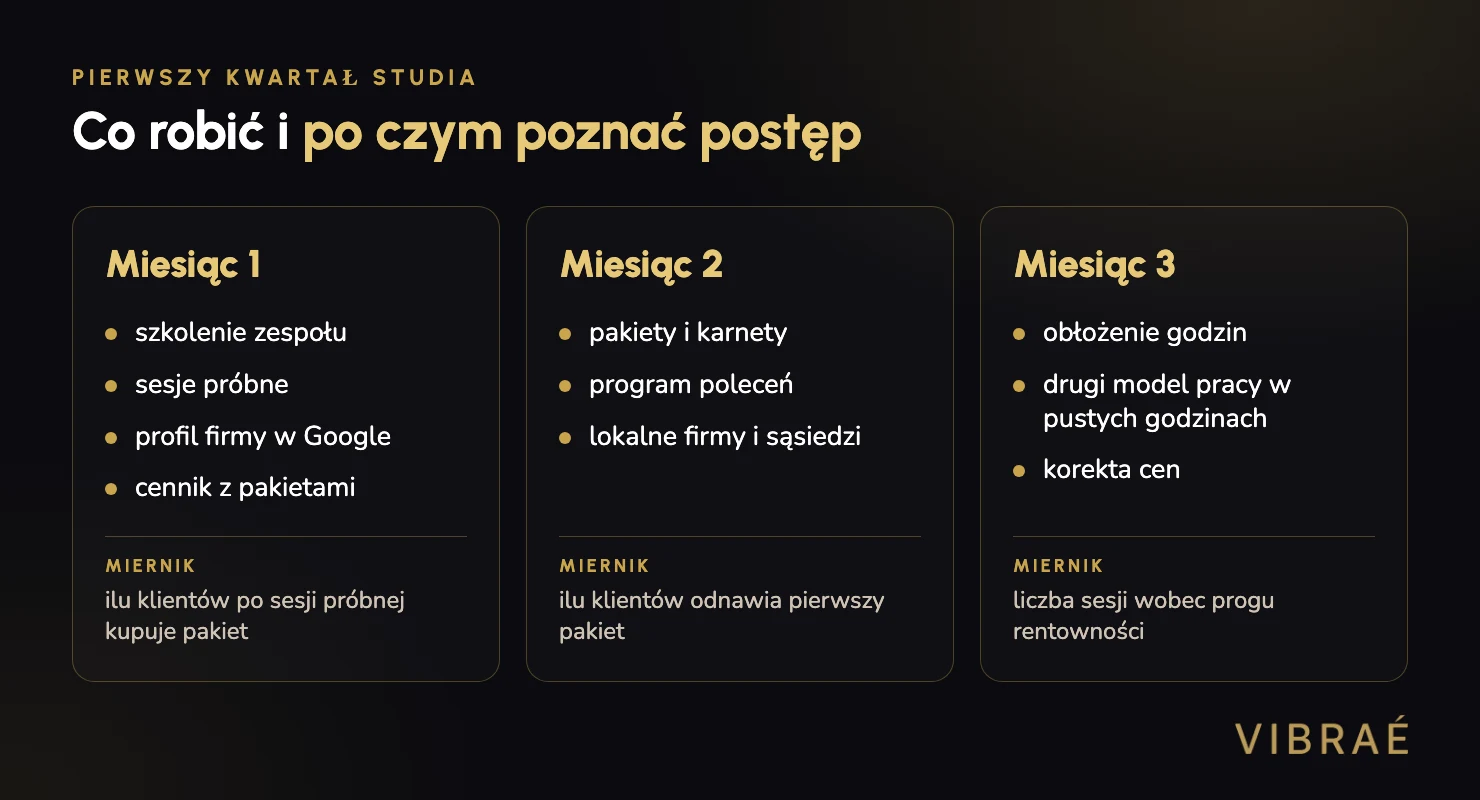
The schedule fills up over months, not weeks, and that is normal. In the first weeks, what matters most is how many clients buy a package after a trial session. If that share is low, the problem lies in the visit itself or in the offer, not in the advertising, so you go back to your standard of work and to what the client hears at the end of the first session.
In the second month it is time for packages, memberships and a referral programme, as well as the first conversations with local businesses. By the third, you can already see which hours are full and which stand empty. Empty mornings and early afternoons are a good place for a second way of working: treatments, sessions for seniors or training in pairs. After a quarter, you compare the number of sessions with the break-even point and decide whether to raise prices, add hours or bring in a second trainer.
Break-even point: when the studio starts paying for itself
The break-even point is the number of sessions whose sale covers all of the month's costs. It is calculated on net amounts:
Break-even point = fixed costs for the month ÷ (session price − variable cost per session)
- Fixed costs are independent of the number of clients: rent, the leasing instalment, software, marketing, bookkeeping.
- Variable cost grows with every session: the trainer's pay settled by the hour, laundry, energy, wear on the suits.
The example below shows only the way of calculating. The amounts are illustrative and are not a forecast for any particular studio.
| Item (example, net) | Amount |
|---|---|
| Rent | 2 500 zł |
| Leasing instalment | 1 099 zł |
| Marketing and other fixed costs | 1 000 zł |
| Total fixed costs | 4 599 zł |
| Session price | 120 zł |
| Trainer's pay per session | 50 zł |
| Margin from one session | 70 zł |
| Break-even point | 4 599 ÷ 70 ≈ 66 sessions a month |
Over 22 working days, that is three sessions a day. Laundry, energy and suit wear are added to the variable cost according to your own bills, so the real break-even point will be slightly higher. If the same trainer works with two people at once, their pay is spread over two sessions: the margin rises to 95 zł (120 − 25), and the break-even point with the same fixed costs drops to about 48 sessions. Keep in mind, however, that a larger set means a higher instalment — and that is the figure you put into the formula.
You can enter your own figures in the calculator on the page Vibraé for training studios: once you switch on the models you run and enter your costs, it shows net profit, margin and payback time. What the revenue itself is made up of is described in the article how much an EMS studio earns, and more broadly about profitability in the article EMS in a training studio: when it pays off.
Five things that slow down the start
- Signing a lease before working out the schedule. The premises should follow from the way you work and the number of sessions, not the other way round.
- Not enough suits in popular sizes. Laundry and sizing quietly eat into the schedule, and a client who hears “we don't have your size today” rarely comes back.
- Too strong a start. A first session at high intensity does not come across as effective. It puts people off and loads the muscles unnecessarily.
- Selling single visits. Results come from regularity, so from the very first visit you offer a series or a package.
- No plan for empty hours. A studio that only waits for evening clients stands empty for most of the day.
Running costs
- Suits. With daily use they wear out faster than in home conditions. You plan a reserve of sizes and enough sets for washing not to block the schedule.
- Washing and drying. The washing machine, energy, products and working time — in line with the manufacturer's instructions.
- Controllers. Charging between sessions needs to be built into the rhythm of the day.
- Service. At Vibraé the warranty covers 12 months on the controller and 12 months on the suits. Service runs door to door: in case of a fault, replacement equipment is sent by courier, so the schedule does not stand still. After the warranty period, service is paid for and carried out in Poland.
- Development. Software, ongoing marketing and training for new team members.
Honestly about the limitations
- The order of steps can be different. A fitness club adding EMS to an existing facility starts with equipment and training, because it already has the premises and the clients.
- How fast the schedule fills depends on the location. Local competition, prices and client habits differ so much between cities that no one can honestly give you a single timeframe.
- Training does not replace experience. The first weeks are a learning period for the trainer too, which is why new clients are guided calmly and without rushing.
- Contraindications apply from day one. We have put together the list that should go into the questionnaire in the article contraindications to EMS training.
- The sample calculation is a method, not a forecast. Rent, session prices and wages differ between cities enough that transferring these numbers directly makes no sense.
- The financing terms cannot be predicted. The bank's decision depends on the situation of the particular company, and nobody on the supplier's side can promise it.
How to get started with Vibraé
We start with a conversation about what kind of studio you want to open and for whom. Then we arrange a test, at your place or ours, so you can feel a session for yourself and check how the station will fit into your premises. Tests are free; they only require agreeing the scope and date in advance. Only after that do we choose the configuration, train your team and help with your first clients. Smaller orders are usually fulfilled straight away, larger configurations within up to three weeks.
Seven training studios currently work on Vibraé equipment and apps, with around 400 people training in them. If you want to check what your station could bring in, enter your own prices and occupancy in the revenue calculator. All forms of cooperation are described on the page Vibraé for partners, the offer for studios is on the page Vibraé Fitness, and you can arrange a conversation using the demo form. If EMS is to be a service in a salon, read the article EMS in a beauty salon.
Where do you start when opening an EMS studio?
With a decision about what kind of studio you are opening and for whom: one-to-one training, work in pairs, small groups or treatments. The way you work determines the premises, the number of controllers and suits, and the schedule, so it is settled before you sign a lease and order equipment.
What kind of premises does an EMS studio need?
An EMS studio does not need a large hall or heavy equipment. It needs room for the client and the trainer to move freely, a changing room and bathroom, a space for washing and drying suits, a permanent place for charging controllers, and privacy. With a dry suit, there is no need to set aside a station for soaking vests.
Do you need a licence to run an EMS studio?
In Poland there is no separate licence for running EMS training, and the trainer profession is not regulated. Training in equipment operation, methodology and safety is still a condition of working responsibly with clients. At Vibraé, onboarding training is included in the price of every set.
What software is useful in an EMS studio?
A system in which clients book their own slots and pay for a session or a package, while the studio sees the schedule, packages that are running out, enquiries from ads, and reports. Vibraé Core Fitness works together with the suit, so every session goes into the client's record.
How do you get your first EMS studio clients?
The work starts a few weeks before opening: a list of people who already know you, a Google business profile with real photos, trial sessions followed by a package offer, cooperation with local businesses, and a campaign targeted at the immediate area.
How long does it take to fill the schedule in a new EMS studio?
It depends on the city, the competition and the client base you start with, so no one can honestly give you a single timeframe. The schedule fills up over months, not weeks. In the first weeks, what matters most is the share of people who buy a package after a trial session.
How much does it cost to open an EMS studio?
There is no single figure — a 1:1 station at an existing gym and three stations in your own premises are two different budgets. The cost estimate is broken down into items: equipment and suits, premises and fit-out, training, software, launch marketing, formalities and working capital for the first months.
How many sessions a month does an EMS studio have to sell to break even?
The break-even point is calculated as fixed costs divided by the margin on a single session. In an example with fixed costs of 4 599 zł net and a margin of 70 zł per session, before laundry and energy costs, that comes to about 66 sessions a month, or three a day over 22 working days.
What formalities are needed to open an EMS studio?
A registered business with the right activity code (usually division 93, e.g. 93.13.Z), agreed VAT rate and a method of accounting for packages, liability insurance covering training with electrostimulation, studio terms and conditions, a health questionnaire compliant with GDPR and equipment with CE marking.
What are the leasing terms for EMS equipment?
The down payment, the length of the agreement and the buy-out value are set by the bank individually for each particular company. The instalment for the smallest set starts from 1,099 PLN net a month, and for larger configurations depends on the size of the order and on leasing capacity. The simulation is prepared by the bank.