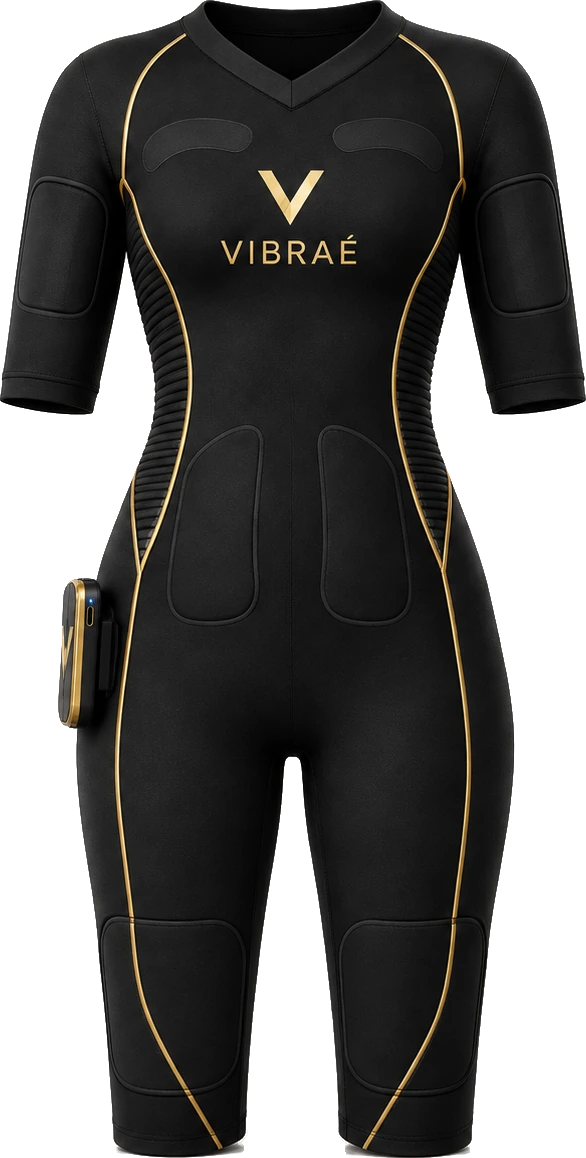
Dividing the EMS market into „wireless” and „cabled” systems sounds like a difference in convenience. In practice it concerns three more serious things: where the control sits, how many layers lie between the electrode and the skin, and how much of each session is eaten up by handling the equipment.
Updated: 21 September 2026
The aim of this text is to describe how a wireless suit is built, to explain what a dry electrode really changes compared with a wetted vest, and to gather the parameters that matter when choosing — and those that are purely marketing material.
What a wireless EMS suit is made of
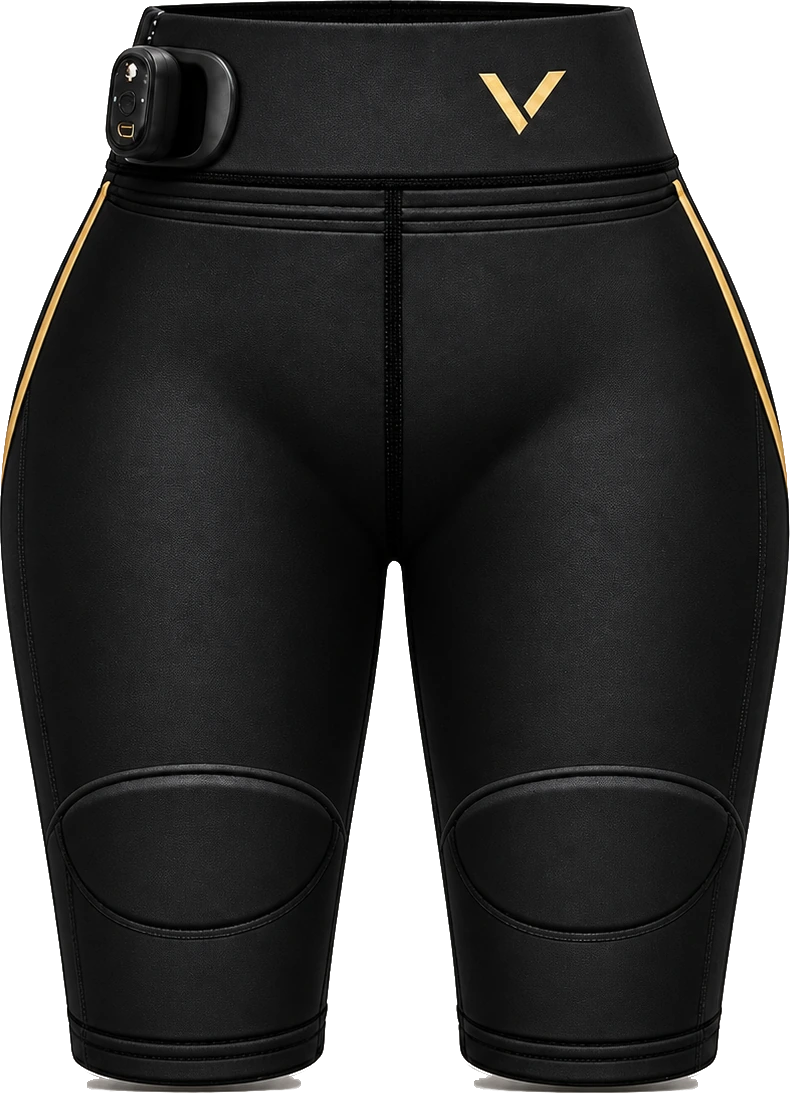
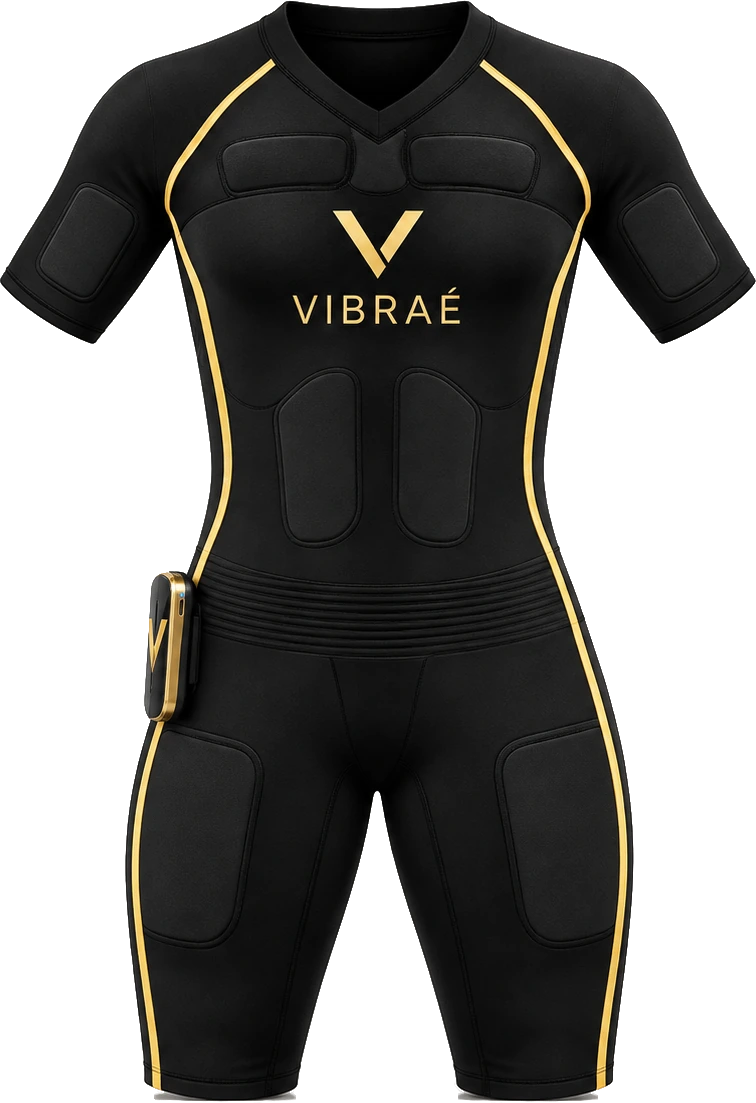
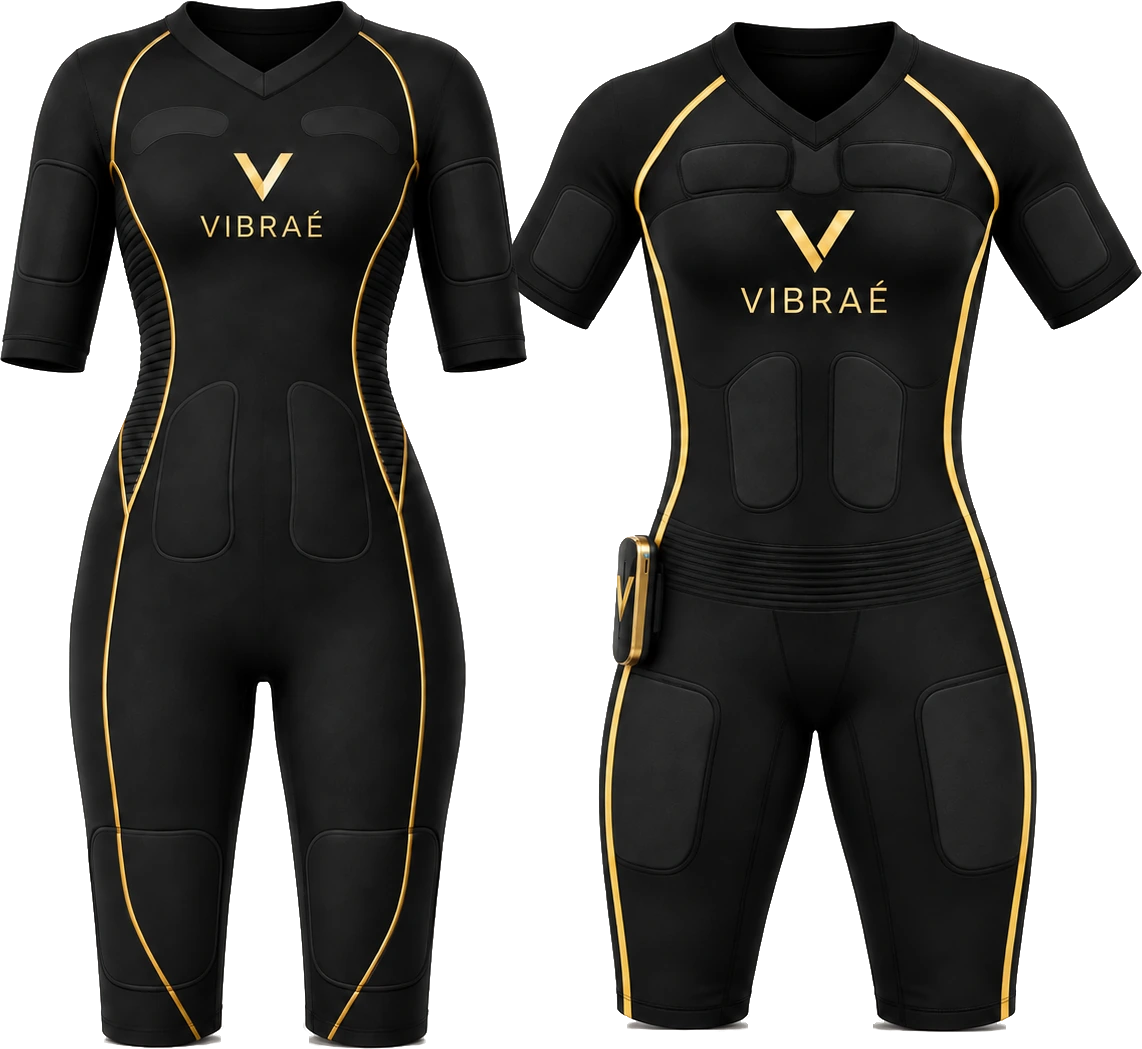
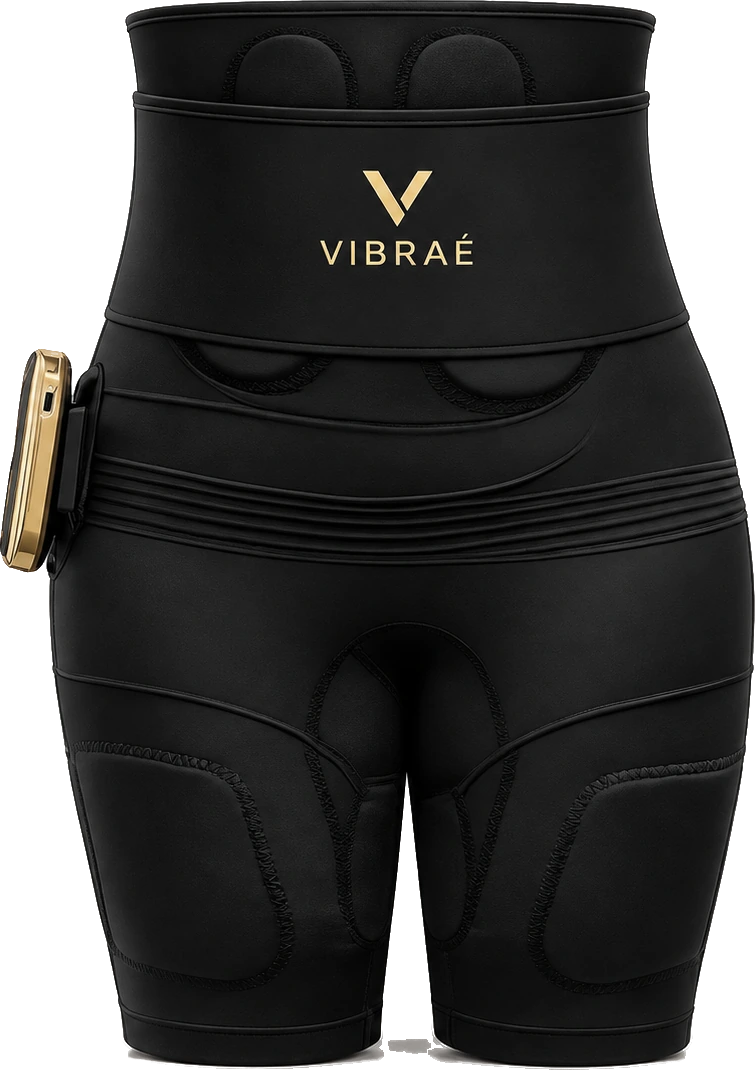
A wireless EMS suit is compression clothing with electrodes sewn in and a control module placed in the suit itself. The whole set-up has three elements:
- Suit — electrodes placed over the main muscle groups, sewn permanently into a highly compressive material that presses them against the skin.
- A controller with a battery — generates the impulse and distributes it to the individual zones. In wireless systems it is fixed in the suit and moves along with the person exercising.
- App — sets the programme, the rhythm of work and rest and the intensity for each muscle group separately.
The difference from a vest system is not the strength of the stimulus but where the control sits. In a stationary system the trainer sets the parameters from the device panel and the client is connected to it by a cable. In a wireless system the control is in the app and the range of movement is not limited by anything.
Wireless versus cabled: what actually changes
| Feature | Wireless suit | Classic wired system |
|---|---|---|
| Connection | the controller in the suit, control over Bluetooth | cables to a stationary device |
| Zakres ruchu | full — walking, changing position, exercising outdoors | within reach of the cables |
| Where the session takes place | home, garden, a trip away | usually a designated station in the studio |
| Electrode preparation | depending on the system — in the Vibraé suit, dry | often wetting with water or gel |
| Who sets the intensity | the user in the app, separately for each muscle group | the trainer from the device panel |
Neither variant is „stronger” by virtue of its construction. What happens in the muscle is decided by the parameters of the impulse, the intensity that has been set and the regularity of the sessions — not by whether the control module stands on a stand or sits in the suit.
A dry electrode versus a wetted vest
The impulse has to travel from the electrode to the skin. In vest systems the intermediary is wetted fabric: water or conductive liquid applied to the vest and belts before the session. It works, but it introduces a variable that cannot be controlled from the panel — the evenness of the soaking. If part of the surface was sprayed more lightly, some electrodes start conducting only after a few minutes, once the material has absorbed sweat.
In a dry construction the intermediate layer disappears. The Vibraé suit uses four-layer silver–silicone electrodes and a conductive fabric with silver fibre; it is put on dry skin or thin underwear, without water and without gel. The stimulus is repeatable from the first minute, and its value depends solely on the settings.
The operational consequence is just as important: wetting, draining and drying the vests disappears, and with it several or more minutes of handling at every session.
When the impulse in one muscle group is clearly weaker
A dry electrode needs to lie closely against the skin. An uneven stimulus in one zone usually has one of four causes, and it is worth checking them in this order:
- Size. Too loose a suit stands away from the body. When choosing between two sizes, take the smaller one.
- Pas. In the Body suit it is fastened at the waist — without that the electrodes on the abdomen and the back lose contact during movement.
- The condition of the skin. A layer of lotion or oil applied just before the session worsens conduction.
- Ustawienie. The intensity is regulated separately for each muscle group, so a weaker zone can be raised without touching the others.
The course of a session in a wireless suit
- Putting on the suit and clipping in the controller. The suit is compressive and should lie close — that is the condition for even contact of the electrodes.
- Connecting to the app, choosing a training or treatment programme.
- A gradual raising of the intensity, group by group. The contraction should be clear, never painful.
- The main part: simple exercises, walking or a lying position with recovery programmes.
- The end, unclipping the controller, hanging up the suit. The app records the session.
In the first sessions a counter-intuitive rule applies: you start at the lowest intensity and raise it over the following weeks, not during the first workout. After a few minutes the same setting may feel stronger — that is a normal reaction, not a fault.
Parameters that matter when choosing
- Zakres pracy. A whole-body suit and shorts are two different tools. What matters is where the electrodes are and how many independent zones there are.
- Independent regulation by muscle group. The thighs usually tolerate much higher values than the abdomen or the arms. One shared regulator for the whole body always means a compromise.
- Impulse parameters. The range of frequency and pulse width determines which programmes can be built on that equipment at all — from strength to recovery.
- Controller. Working time on one charge, the way of charging, the weight and how it is fixed in the suit.
- Oprogramowanie. Does the app only give the power, or does it run the session: phases, the rhythm of work and rest, a record of history.
- Sizes and cut. The size chart, the cut variants, the terms of exchanging a size after purchase.
- Washing and durability. Whether the suit can be machine-washed and at what temperature — with regular use this is an operating parameter, not a detail.
- Warranty and service. The length of the warranty, the course of a repair, the availability of parts and the terms of return.
The Vibraé system in numbers
| Parameter | Body (full body) | Slim shorts | Mini shorts |
|---|---|---|---|
| Electrodes | 20 (10 pairs) | 12 (6 zones) | 8 (4 zones) |
| Areas | the back, the abdomen, the glutes, the thighs, the arms | abdomen, lower back, thighs, glutes | thighs, glutes, love handles |
| Controller | Smart Box, 2000 mAh, approx. 6 h of runtime | Smart Box, 2000 mAh, approx. 6 h of runtime | Mini Smart Box, 60–90 min of runtime |
| Set price | 15 449 zł | 15 999 zł | 6 150 zł |
Parameters shared by the sets with a Smart Box: USB-C charging in about 2 hours, Bluetooth Low Energy connectivity, impulse frequency 3–90 Hz, pulse width 120–450 µs, washing at 30 °C in a laundry bag. Sizes: Body unisize XS–3XL, fitted Body XS–XXL, Slim and Mini shorts S–XXL. The set contains the suit, the controller, a USB-C cable and the Vibraé EMS and Vibraé Home apps, plus 12 months of warranty, 14 days for returns and a free size exchange for three months from purchase.
A comparison of all the variants is gathered in the categories EMS suits i EMS shorts, and a description of the whole system can be found on the page Vibraé Home Edition.
Size, washing, one suit per person
Size. You measure the circumference of the chest, waist and hips — on bare skin or thin underwear, with a tape that lies flat but does not dig in — and compare it with the table on the product page. The suit has to fit closely, because only then do the electrodes work evenly. At Vibraé exchanging the size is free for three months from purchase; the shipping cost remains.
Washing. The controller is taken out before washing. The suit is machine-washed at up to 30 °C, in a laundry bag, without softener, without bleach and without dry cleaning; it is not ironed and dries naturally, in the shade. The conductive fibres are sewn in permanently, so nothing has to be unclipped.
One suit, one person. The compression and the cut are matched to a particular body, so two people need two suits in their own sizes. The couples set contains two suits, and one controller runs one session — simultaneous training requires a second controller.
Honestly about the limitations
- The absence of a cable does not increase effectiveness. It changes the ergonomics and the place of training, not the physiology of the contraction.
- Sucha elektroda wymaga dopasowania. A badly chosen size can spoil a session more effectively than any parameter of the equipment.
- Sterownik ma ograniczony czas pracy. With the Mini Smart Box that is 60–90 minutes, which with several sessions a day means charging has to be planned.
- No trainer means the responsibility has moved. The qualification, the choice of intensity and recognising situations that require a session to be stopped pass to the user.
- The suit is a consumable item of equipment. With regular use and washing it wears out — that is a normal cost, not a fault.
Safety
The Vibraé suit is not a medical device and does not replace treatment. It should not be used with an implanted pacemaker or another electronic implant, in pregnancy, with epilepsy or with cardiac arrhythmias. You do not train with an acute infection, a fever or after alcohol. With chronic illnesses, after surgery and in case of any doubt, the decision belongs to a doctor.
The rules for a safe start are simple: gentle first sessions, full hydration before and after the workout, and — with very strong, increasing muscle pain or dark urine — contact with a doctor. We gathered the full list of contraindications together with the reasoning in the article contraindications to EMS training.
Summary
The wireless design and the dry electrode solve two specific problems: they free movement from the cable and remove the variable of how evenly the fabric is wetted. They do not, however, change what the result depends on — the session parameters, the intensity matched to adaptation, and consistency.
For those wondering about their own set instead of sessions in a studio, we set out the whole calculation in the article Investing in EMS: training in a studio or your own equipment at home.
What is a wireless EMS suit?
It is compression clothing with electrodes sewn in and a control module placed in the suit itself. The impulse is set by the app over Bluetooth, so there are no cables leading to a stationary device and the range of movement is not limited.
Does a wireless suit work more weakly than a cabled studio system?
No. The strength of the stimulus is determined by the impulse parameters and the intensity set, not by where the control module sits. The wireless design changes the ergonomics and the place of training, not the physiology of the contraction.
Does the Vibraé suit have to be wetted with water or gel?
No. Four-layer silver-silicone electrodes and fabric with silver fibre conduct the impulse dry — the suit is put on over the skin or thin underwear. In wetted vests the evenness of soaking determines how repeatable the stimulus is; here that variable does not exist.
Why is the impulse in one muscle group sometimes weaker?
The most common causes are too loose a size, an unfastened belt in the Body suit, a layer of lotion on the skin, or simply a lower setting for that area. The intensity is adjusted separately for each zone, so a weaker spot can be raised without changing the others.
What are the parameters of the Vibraé suit?
Impulse frequency 3–90 Hz, pulse width 120–450 µs, Bluetooth Low Energy connectivity, USB-C charging in about 2 hours. The Smart Box has 2000 mAh and runs for about 6 hours, the Mini Smart Box 60–90 minutes. The Body suit has 20 electrodes, Slim 12, Mini 8.
How do I wash the EMS suit?
The controller is taken out before washing, and the suit is machine-washed at up to 30 °C, in a laundry bag, without softener and without bleach. No dry cleaning and no ironing; dry naturally, in the shade. The conductive fibres are sewn in permanently.
Can more than one person use a single suit?
The suit is compressive and selected for a particular figure, so each person needs their own size. The couples' set contains two suits, but one controller runs one session — training at the same time requires a second controller.
How much does a wireless Vibraé EMS suit cost?
The Body set costs 15,449 PLN, the Slim shorts 15,999 PLN and the Mini shorts 6,150 PLN. The price includes the suit, the controller, a USB-C cable and the apps, 12 months of warranty, 14 days to return and a free size exchange for three months from purchase.